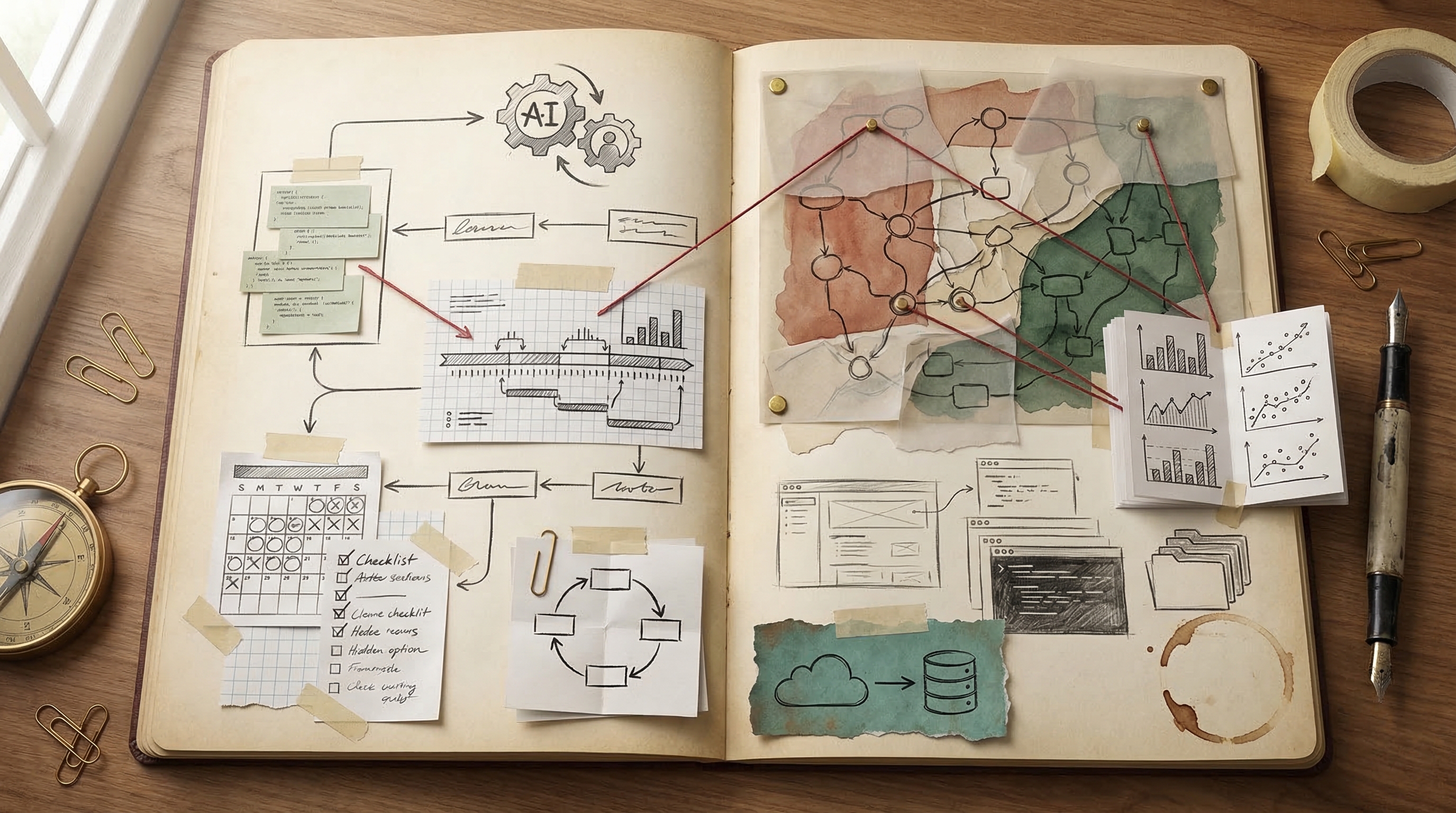
What It's Actually Like to Use Claude Code for Everything
338 sessions, 256 commits, 924 hours — an honest account of treating AI as an engineering partner
There's a version of this post that just shows you the numbers: 338 sessions, 256 commits, 924 hours, 5 projects. But numbers don't capture what it actually feels like to treat an AI as your primary engineering partner for two months straight.
So here's the honest version.
The Working Dynamic
I'm a power user who treats Claude Code as an always-on operational partner, not just a coding assistant. Across 338 sessions and nearly 1,000 hours, I've built a remarkably consistent workflow: I feed Claude real-world context — meeting transcripts, stakeholder emails, API docs, project proposals — and expect it to translate messy business inputs into structured, multi-file outputs with minimal hand-holding. My Obsidian vault management is a signature pattern: I repeatedly ask Claude to ingest raw information (onboarding notes, org charts, vendor data, meeting transcripts) and produce interconnected notes, project briefs, and people profiles. I do the same with code — driving full feature lifecycles from brainstorm through PR and deployment in single sessions. My top tool usage (4,135 Bash calls, 3,412 Reads, 2,682 Edits) confirms I let Claude run autonomously through complex multi-file operations rather than micromanaging individual steps.
My friction patterns reveal a clear preference: I want execution, not deliberation. The most recurring issues are Claude taking a wrong approach (54 instances) or producing buggy code (56 instances), but notably I almost never interrupt (only 1 recorded interruption) — instead I correct course with quick follow-up messages. When I do get frustrated, it's almost always because Claude over-plans or over-engineers: interrupting excessive plan mode responses, stopping Claude from escalating a simple curiosity question into full architecture planning, or cutting off structured review workflows when I want to move faster. I rejected actions only 6 times across hundreds of sessions, showing me generally trust Claude's judgment but have a low tolerance for scope creep and excessive planning (4 instances flagged). The 108 successful multi-file changes versus only 2 "excessive changes" friction events show Claude has largely learned to match my appetite for sweeping edits.
My work spans a fascinating hybrid role — I'm clearly a Director-level operator building intelligent systems who uses Claude for both knowledge management (Obsidian vaults, meeting prep, stakeholder communication) and hands-on engineering (TypeScript apps, Azure deployments, Stripe integrations, Remotion video projects). With a 91 fully-achieved and 56 mostly-achieved success rate out of 185 analyzed sessions, and 390 "likely satisfied" ratings, I've found a productive groove. My 256 commits across ~2 months suggest I'm shipping almost every day. The pattern is unmistakable: I bring the strategic context and domain knowledge, point Claude at a clear objective, and expect it to execute end-to-end with production-quality results — correcting it when it drifts but otherwise staying out of the way.
The one-line summary: I operate as a high-context delegator who feeds Claude raw business inputs and expects autonomous, multi-file execution with minimal planning overhead — correcting course quickly when it over-engineers but otherwise letting it run.
What This Looks Like Day to Day
Most sessions follow the same arc: I describe what I want at a high level, Claude decomposes it into steps, and then we iterate. The good sessions feel like pair programming with someone who types infinitely fast. The bad sessions feel like managing a junior developer who keeps misunderstanding the architecture.
The difference between the two? Specificity. When I say "add a delete button to the user profile with a confirmation modal that calls the existing deleteUser API endpoint," Claude nails it. When I say "improve the settings page," Claude spends 8 minutes reading files and writing plans without producing code.
The Projects
Obsidian Knowledge Vault / Second Brain
18sessions
Built and maintained an Obsidian vault for a Director of Intelligent Systems role, including meeting notes from transcripts, project briefs, people/stakeholder profiles, org charts, vendor notes, onboarding plans, and weekly report automation. Claude Code was used extensively for multi-file creation and editing, structuring information from meeting transcripts and emails, maintaining cross-references between notes, and initializing git for the vault.
the platform SaaS Platform Development
25sessions
Developed a full-stack SaaS product (the platform) with features including embeddable chat widgets, Stripe Connect payments, page ownership transfer, dashboard simplification, simulation scoring/history, onboarding flows, voice agent mode, analytics, and code review workflows. Claude Code drove feature implementation across TypeScript/React codebases, managed PRs, ran architecture audits with parallel sub-agents, and handled deployment to Vercel and Azure.
Insurance Marketing Website
5sessions
Maintained and deployed updates to an insurance marketing site including copy changes, page additions/removals, favicon updates, Google Analytics implementation, Resend email integration, changelog replacement, and featured blog posts. Claude Code handled multi-file edits, builds, and pushes to main, resolving deployment issues like Resend API key initialization at build time.
Enterprise Integration & Automation Projects
8sessions
Worked on enterprise integration projects including an HR platform-to-a partner system data mapping, an RPA vendor/RPA coordination, process automation research, AP invoice processing, and Azure infrastructure provisioning for an MVP app. Claude Code was used to research APIs, draft stakeholder communications, document technical findings, resolve mapping questions, and provision cloud infrastructure despite Azure quota limitations.
Remotion Video & Media Production
3sessions
Created animated explainer videos using Remotion, including a full project scaffold with design tokens, shared components, seven scenes, and orchestration for a platform product demo. Claude Code implemented the entire Remotion project structure, fixed TypeScript/Webpack build issues, and verified scene rendering, though one session stalled in planning without producing output.
The Meta-Pattern
After 338 sessions, the pattern that matters most isn't any specific technique — it's the speed of the feedback loop. The faster you can tell Claude what's wrong and get a correction, the more productive you are. Every workflow optimization I've found boils down to: reduce the time between "that's wrong" and "now it's right."